BIS Hallmarking for Gold & Silver Jewellery: Why It Is Required, Registration Process, Timelines & How Manufacturers and Jewellers Can Get Compliant
Gold and silver jewellery are high-value products where purity directly affects the value paid by the customer. Unlike many ordinary products, the purity of a precious-metal article cannot be reliably established simply by looking at or handling the jewellery. This is why the Bureau of Indian Standards (BIS) operates the hallmarking system in India.
Hallmarking provides an independent indication of the fineness of precious-metal articles and is intended to protect consumers against adulteration while encouraging manufacturers and sellers to maintain legally prescribed standards of purity.
If you manufacture, supply or sell precious-metal jewellery or artefacts covered by the applicable hallmarking requirements, BIS registration and hallmarking should be treated as an important part of your product-compliance process—not merely as a marking requirement.
What Is BIS Hallmarking?
BIS defines hallmarking as the accurate determination and official recording of the proportionate content of precious metal in precious-metal articles. In India, gold and silver are currently covered under the hallmarking framework.
The principal objectives are to protect consumers from irregularities relating to gold and silver purity, encourage conformity with legal standards of fineness and support confidence in the precious-metals market.
Why Is BIS Hallmarking Important for Manufacturers and Jewellers?
For a manufacturer or jeweller, hallmarking is not simply about putting a symbol on a product. It creates a system through which the declared purity of the article is independently assessed before it reaches the consumer.
- Consumer confidence: Hallmarking provides third-party assurance regarding the purity/fineness of the precious-metal article.
- Regulatory compliance: Businesses covered by the applicable requirements need to follow the BIS hallmarking framework before selling relevant hallmarked articles.
- Brand credibility: Demonstrating compliance helps establish a stronger quality image for a jewellery business.
- Traceability: The HUID system provides a unique identification mechanism for hallmarked gold jewellery.
- Reduced customer disputes: Proper hallmarking and authentic invoicing provide stronger documentation around the article sold.
BIS specifically states that hallmarking provides customers with third-party assurance that they receive the appropriate purity of gold or silver for the value paid.
Who Needs BIS Registration for Hallmarked Jewellery?
According to the current BIS guidance, any manufacturer, wholesaler, distributor or retailer engaged in selling hallmarked precious-metal articles is required to obtain BIS registration, subject to the applicable provisions, exemptions and mandatory-hallmarking requirements.
BIS also specifies an exemption for jewellers having annual turnover up to ₹40 lakh from the mandatory registration requirement, while such jewellers may voluntarily obtain registration if they wish to sell hallmarked jewellery. Certain artisans or manufacturers working purely on a job-work basis and not directly involved in sale within the relevant chain may also be exempt, subject to the applicable conditions and supporting documentation.
Applicability depends on the nature of the business, article, location and the latest mandatory-hallmarking orders and exemptions. Manufacturers and jewellers should therefore verify the current BIS requirements before starting or expanding operations.
What Does the BIS Hallmark on Gold Jewellery Contain?
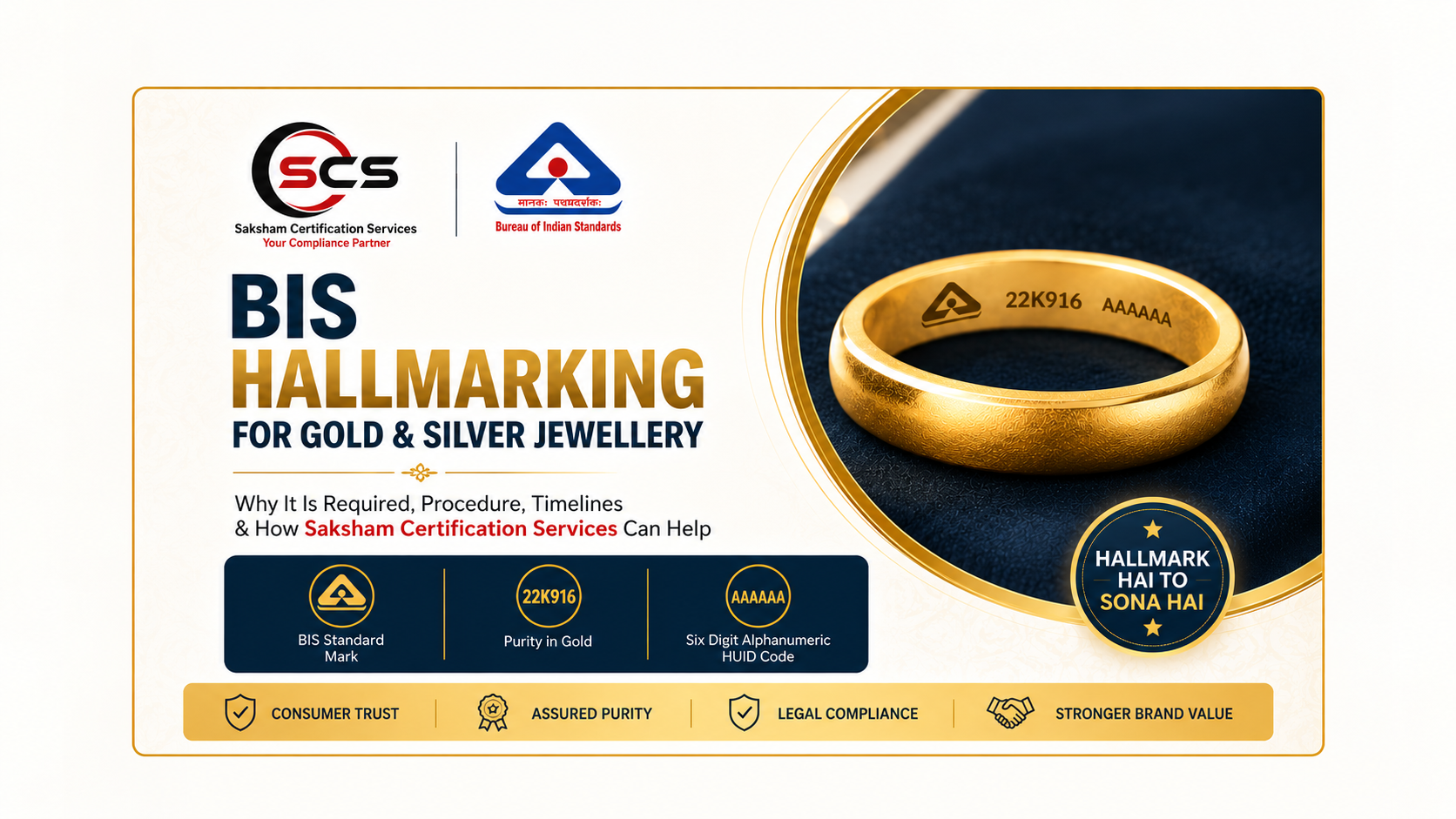
Since the introduction of the HUID system, the hallmark on gold jewellery consists of three principal components:
1. BIS Logo
Indicates the BIS hallmarking framework.
2. Purity / Fineness
Shows the applicable caratage and fineness of the precious-metal article.
3. HUID
A unique six-digit alphanumeric Hallmark Unique Identification number associated with the hallmarked article.
Consumers can verify the HUID using the Verify HUID facility in the BIS Care App. This helps provide additional traceability and confidence when purchasing hallmarked gold jewellery.
Permitted Gold and Silver Fineness Grades
The applicable Indian Standards specify permitted grades for hallmarking. BIS currently lists the following grades under the relevant standards:
| Metal | Permitted Grades | Relevant Standard |
|---|---|---|
| Gold | 14K (585), 18K (750), 20K (833), 22K (916), 23K (958), 24KS (995) | IS 1417:2016 |
| Silver | 800, 835, 900, 925, 970, 990 | IS 2112:2014 |
The applicable grade and marking requirements should always be checked against the latest BIS standard, regulations and mandatory-hallmarking orders.
BIS Hallmarking: Registration vs. Actual Hallmarking
One of the most common misunderstandings is treating BIS jeweller registration and hallmarking of jewellery as the same activity. They are related, but they are not the same.
BIS Registration: Authorizes the eligible jeweller/business to operate within the BIS registration framework for selling hallmarked articles.
Hallmarking: The jewellery is submitted to a BIS-recognized Assaying & Hallmarking Centre (AHC), where the article is assessed and, when it meets the applicable requirements, the hallmark is applied.

Step-by-Step Procedure for BIS Hallmark Registration
The current BIS process is significantly simpler than many manufacturers and jewellers expect. BIS states that a jeweller seeking registration for selling hallmarked gold and silver jewellery/artefacts can apply online through the National Single Window System (NSWS), accessible directly or through the BIS Manakonline portal.
- Assess applicability: Determine whether your business and products fall within the applicable hallmarking and registration requirements.
- Prepare business information: Keep the required business and outlet details ready for the application.
- Create/access the online application: Use the BIS/Manakonline system and the integrated NSWS process.
- Submit the registration application: Enter the required details and submit the application online.
- Receive the registration: BIS states that the jeweller registration is granted instantly when the application meets the prescribed requirements.
- Arrange hallmarking: Submit jewellery through the portal to a BIS-recognized Assaying & Hallmarking Centre for the required testing and hallmarking process.
BIS's current guidance states that jeweller registration is free of cost and valid for lifetime. The revised BIS guidelines also state that the registration is granted instantly and that the registration number is communicated through email/SMS.

What Is the Application Timeline?
Manufacturers and jewellers should distinguish between the BIS registration timeline and the operational timeline for getting jewellery hallmarked.
| Activity | Current Position |
|---|---|
| BIS Jeweller Registration | Instant grant, subject to eligibility and prescribed requirements |
| Registration Fee | No fee for grant of jeweller registration as per current BIS guidance |
| Registration Validity | Lifetime |
| Hallmarking at AHC | Depends on the consignment, article, AHC workflow and applicable testing requirements; there is no single universal processing time that should be promised to every applicant. |
This is important because older online articles may still quote multi-day timelines for BIS jeweller registration. The current BIS guidance says that jeweller registration is granted instantly.
How Does a Jeweller Send Jewellery for Hallmarking?
After registration, the jeweller can use the BIS Manakonline system to create a hallmarking request. BIS describes the process as follows:
- Log in to the BIS/Manakonline portal.
- Select the Hallmarking section.
- Select New Request.
- Select the Assaying & Hallmarking Centre.
- Enter the required details such as item category, quantity, weight and declared purity.
- Submit the jewellery/consignment to the selected BIS-recognized AHC as per the prescribed procedure.
What Happens at an Assaying & Hallmarking Centre?
The Assaying & Hallmarking Centre plays a critical role because the jewellery must be assessed before the hallmark is applied. The process involves examination and testing of the precious-metal article against the applicable requirements.
Depending on the applicable procedure, precious-metal assaying can involve techniques including X-ray fluorescence screening and prescribed analytical methods. BIS recognizes specific standards for the operation of AHCs and for determination of gold and silver content.
What Are the Current Hallmarking Charges?
BIS currently lists the following hallmarking charges in its FAQ:
BIS also specifies minimum consignment charges of ₹200 for gold and ₹150 for silver, with applicable taxes and levies extra. Hallmarking charges are based on the number of articles rather than their weight.
What Should a Customer Check Before Buying Hallmarked Jewellery?
BIS hallmarking is also designed to make the purchasing process more transparent for customers. A customer should not rely only on the word of the seller when purchasing a high-value precious-metal article.
- Look for the applicable BIS hallmark on the article.
- Check the purity/fineness marking.
- Check the six-digit HUID on hallmarked gold jewellery.
- Verify the HUID using the BIS Care App.
- Purchase from a BIS registered/certified jeweller.
- Always obtain an authentic bill/invoice containing the required details of the hallmarked article.
BIS also advises registered/certified jewellers to display the BIS logo with the wording indicating that hallmarked jewellery is available for sale, display their registration certificate, keep a minimum 10X magnifying glass for showing the hallmark to customers and display the relationship between fineness and caratage.
Why Manufacturers Should Not Wait Until the Last Moment
A common mistake is to start the compliance process only after jewellery production or sales have already begun. Although the current jeweller registration itself is designed to be granted instantly, businesses still need to understand their applicability, prepare their operational process and establish a proper workflow for sending articles to recognized hallmarking centres.
A manufacturer or jeweller should therefore consider hallmarking compliance at the product-planning and sales-process stage. This becomes especially important when a business has multiple outlets, multiple product categories, large volumes or supply-chain transactions involving manufacturers, wholesalers, distributors and retailers.
What Is the Responsibility in the Supply Chain?
BIS states that where a precious-metal article moves through a chain involving a manufacturer, wholesaler, distributor and retailer, the responsibility to get the article hallmarked rests with the party making the first point of sale. Hallmarking is therefore not intended to be unnecessarily repeated at every stage of the same sale chain.
Businesses should nevertheless maintain appropriate commercial and traceability records and assess their specific transactions against the latest BIS requirements.
Recent Regulatory Updates: Why You Should Check the Latest BIS Notifications
Hallmarking requirements and their geographical/product applicability can be updated through government notifications, amendments and mandatory-hallmarking orders. BIS's official mandatory-hallmarking page currently lists amendments through August 2026, including updates dated March, April and August 2026.
This means that businesses should not depend exclusively on an old blog, consultant article or previously downloaded notification. Before launching a new jewellery product, opening a new outlet or changing the supply chain, it is advisable to verify the latest BIS position.
How Saksham Certification Services Can Help
For a manufacturer or jeweller, the biggest challenge is often not understanding what a hallmark is—it is knowing exactly what applies to the business, preparing the application correctly and establishing a practical compliance workflow.
Saksham Certification Services can support businesses through the BIS hallmarking compliance journey with a practical, documentation-focused approach.
Our support can include:
- Applicability assessment – understanding whether BIS registration and hallmarking requirements apply to your business and products.
- Documentation guidance – helping organize the information and documents required for the registration process.
- Online application support – assistance with the BIS/Manakonline registration workflow.
- Hallmarking process guidance – helping manufacturers and jewellers understand the process of submitting articles to recognized AHCs.
- Compliance workflow support – guidance on integrating hallmarking requirements into purchasing, production, inventory and sales processes.
- Regulatory update support – helping businesses remain aware of changes that may affect applicability and compliance.
- End-to-end certification assistance – a single point of support for businesses that need structured assistance with BIS and other product-compliance requirements.
A Practical Compliance Checklist for Manufacturers & Jewellers
Final Takeaway
BIS hallmarking is fundamentally about trust, purity and consumer protection. For a manufacturer or jeweller, compliance should not be viewed as a last-minute formality. It should be incorporated into the business process from product manufacturing and sourcing through hallmarking and final sale.
The good news is that the current BIS jeweller-registration process is online, free of cost and, according to BIS, granted instantly and valid for lifetime. The important part is ensuring that your business is correctly classified, the applicable requirements are understood and the jewellery is routed through the prescribed hallmarking process.
If you are a jewellery manufacturer, wholesaler, distributor, retailer, showroom owner or business planning to enter the precious-metal jewellery market, Saksham Certification Services can help you understand the applicable BIS requirements and organize the compliance process in a structured manner.
Need Assistance with BIS Hallmarking?
Get professional guidance for BIS Hallmark Registration, applicability assessment, documentation and compliance support.
Contact UsDisclaimer
The information provided in this article is intended for general awareness and educational purposes only. It has been prepared based on information available from the Bureau of Indian Standards (BIS) and related regulatory sources at the time of publication. BIS rules, regulations, standards, mandatory hallmarking orders, exemptions, fees, procedures and applicability may be amended or updated from time to time.
This article should not be considered legal, regulatory or professional certification advice and does not constitute a guarantee of registration, approval, certification or grant of any licence. The actual applicability and requirements may vary depending on the nature of the business, product, location and prevailing regulatory provisions.
Readers and businesses are advised to verify the latest requirements directly from the official BIS website and applicable government notifications before taking any compliance or commercial decision. Saksham Certification Services shall not be responsible for any loss, liability or consequence arising from reliance solely on the information contained in this article.