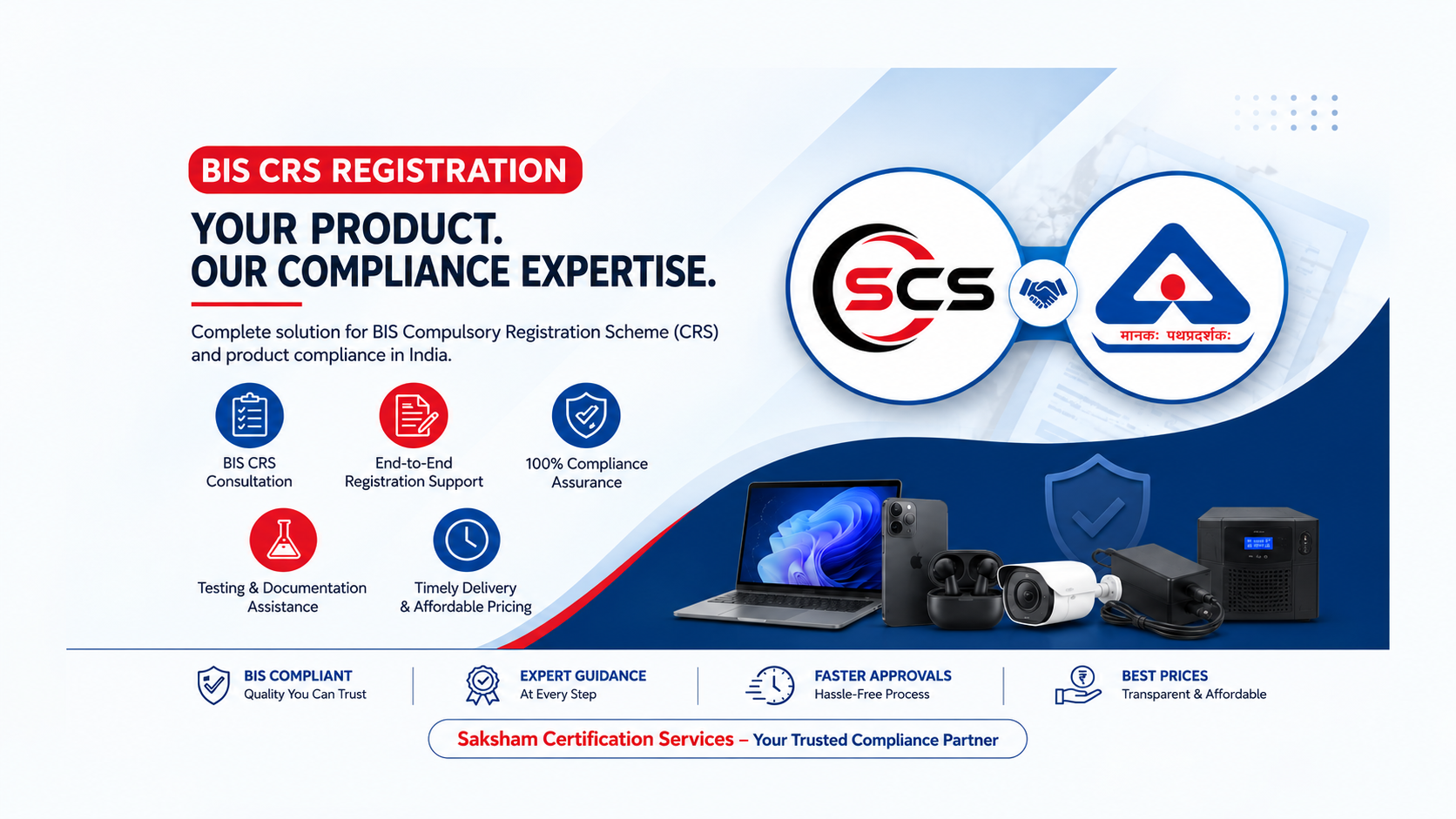
Complete Guide to BIS Compulsory Registration Scheme in India
BIS Compulsory Registration Scheme (CRS) is an important regulatory requirement for manufacturers of specified electronic, IT and other products intended to be manufactured, imported, distributed or sold in the Indian market. This guide explains BIS CRS registration, applicable products, requirements, documents, registration process, testing, validity, renewal and other important compliance considerations.
What is BIS Registration?
The Bureau of Indian Standards (BIS) is India's National Standards Body and operates under the Bureau of Indian Standards Act, 2016. BIS works in areas including standards formulation, product certification, testing, laboratory services, hallmarking and conformity assessment.
BIS certification is generally voluntary; however, the Government of India makes compliance compulsory for specified products through applicable regulations and Quality Control Orders (QCOs). For products covered by compulsory requirements, manufacturers must meet the applicable Indian Standard and follow the relevant BIS conformity assessment route before the product is placed in the Indian market.
BIS therefore provides an important framework for product quality, safety and conformity with Indian Standards. The official BIS product-certification framework identifies several compulsory conformity assessment schemes, including Scheme-II, known as the Registration Scheme.
What is BIS Compulsory Registration Scheme (CRS)?
The Compulsory Registration Scheme (CRS) was introduced for specified electronic and IT products to ensure that products supplied in India conform to applicable Indian Standards. Under CRS, eligible manufacturers are required to obtain BIS registration based on conformity of the product with the applicable standard and the prescribed testing and documentation requirements.
The CRS framework is particularly important for electronic and information technology products. The applicable product categories, Indian Standards and notifications are notified by the concerned Government authorities and updated from time to time.
BIS's current Scheme-II information covers electronics and IT goods notified under the Compulsory Registration Scheme and also includes specified products notified by other ministries, including solar photovoltaic products, certain chemicals and textile products.
Why is BIS CRS Registration Required?
The objective of compulsory registration is to ensure that specified products entering the Indian market satisfy prescribed safety and quality requirements. Regulatory compliance also helps reduce the circulation of substandard products and provides greater confidence to consumers, businesses and other stakeholders.
For a product covered under a compulsory registration requirement, obtaining the applicable BIS registration before commercial placement in India is an important legal compliance step. The exact obligation depends on the product category and the notification applicable to that product.
Who Needs BIS CRS Registration?
BIS CRS registration is primarily relevant to manufacturers of products covered under the applicable Compulsory Registration Scheme. Manufacturers may be located in India or outside India, depending on the product and applicable regulatory requirements.
Importers, distributors and sellers should also ensure that products they intend to place in the Indian market are compliant with the applicable BIS requirements. The registration itself is generally associated with the manufacturer and the covered product, so determining the correct manufacturer, factory and product scope is an important part of the compliance process.
Products Covered Under BIS Registration Scheme
The BIS CRS framework covers a wide range of electronic, IT, solar photovoltaic and other notified products. The product list is periodically amended by the Government. Some commonly encountered categories include laptops, mobile phones, televisions, power adapters, electronic games, printers, scanners, UPS systems, speakers, LED lighting products, photovoltaic products and other notified goods.
The following table reorganizes the product list from the reference material into an easier-to-read alphabetical format. The applicable standard shown below is based on the supplied reference material; manufacturers should verify the current BIS Scheme-II listing before relying on any individual standard because BIS has issued subsequent amendments and standard updates.
| Product | Applicable Indian Standard / Reference |
|---|---|
| Adaptors – Household & Similar Electrical Appliances | IS 302 (Part 1): 2008 |
| Amplifiers | IS 616:2017 |
| Automatic Data Processing Machines | IS 13252 (Part 1):2010 |
| Automatic Teller Cash Dispensing Machines | IS 13252 (Part 1):2010 |
| Barcode Readers | IS 13252 (Part 1):2010 |
| Barcode Scanners | IS 13252 (Part 1):2010 |
| Bluetooth Speakers | IS 616:2017 |
| Cash Registers | IS 13252 (Part 1):2010 |
| CCTV Cameras | IS 13252 (Part 1):2010 |
| CCTV Recorders | IS 13252 (Part 1):2010 |
| Copying Machines / Duplicators | IS 13252-1 |
| Crystalline Silicon Terrestrial Photovoltaic Modules | IS 14286 / IS/IEC 61730-1 / IS/IEC 61730-2 |
| DC or AC Supplied Electronic Control Gear for LED Modules | IS 15885 (Part 2/Sec 13) |
| Digital Cameras | IS 13252 (Part 1):2010 |
| Dimmers for LED Products | IS 60669-2-1:2008 |
| Electronic Clocks | IS 302-2-26:2014 |
| Electronic Games / Video Games | IS 616:2017 |
| Electronic Musical Systems | IS 616:2017 |
| Emergency Lighting | IS 10322-5:8:2013 |
| Fixed General Purpose LED Luminaires | IS 10322 (Part 5/Sec 1) |
| Induction Stoves | IS 302-2-6:2009 |
| Inverters | IS 16242 (Part 1):2014 |
| Iris Scanners | IS 13252 (Part 1) |
| Keyboards | IS 13252 (Part 1):2010 |
| Laptops | IS 13252 (Part 1):2010 |
| LED Flood Lights | IS 10322-5:5:2013 |
| LED Hand Lamps | IS 10322-5:6:2013 |
| LED Lighting Chains | IS 10322-5:7:2013 |
| LED Luminaires for Road and Street Lighting | IS 10322 (Part 5/Section 3):2012 |
| LED TVs | IS 616:2017 |
| Lighting Chains | IS 10322 (Part 5/Sec 9):2017 |
| Mail Processing Machines | IS 13252 (Part 1):2010 |
| Microwave Ovens | IS 302-2-25:2014 |
| Mobile Phones | IS 13252 (Part 1):2010 |
| Notebook / Tablet PCs | IS 13252 (Part 1):2010 |
| Optical Disc Players | IS 616:2017 |
| Optical Fingerprint Scanners | IS 13252-1 |
| Ortho Phosphoric Acid | IS 798:2020 |
| Passports Readers | IS 13252 (Part 1):2010 |
| Plasma / LCD / LED Televisions | IS 616:2017 / applicable current notification |
| Plotters | IS 13252 (Part 1):2010 |
| Point of Sale Terminals | IS 13252-1:2010 |
| Power Adapters for Audio, Video & Similar Electronic Apparatus | IS 616 |
| Power Adapters for IT Equipment | IS 13252 |
| Power Banks | IS 13252 (Part 1):2010 |
| Power Converters for Photovoltaic Power Systems | IS 16221 (Part 2) |
| Power Inverters | IS 16221 (Part 2):2015 |
| Printers | IS 13252 (Part 1):2010 |
| Projectors | IS 13252 (Part 1):2010 |
| Recessed LED Luminaires | IS 10322-5:2:2012 |
| Rice Cookers | IS 302-2-15:2009 |
| Scanners | IS 13252 (Part 1):2010 |
| Sealed Secondary Batteries | IS 16046:2018 |
| Sealed Secondary Cells | IS 16046:2018 |
| Set Top Boxes | IS 13252 (Part 1):2010 |
| Smart Card Readers | IS 13252 (Part 1):2010 |
| Smart Speakers | IS 616 |
| Smart Watches | IS 13252 (Part 1):2010 |
| Standalone LED Modules for General Lighting | IS 16103 (Part 1):2012 |
| Standalone Switch Mode Power Supplies (SMPS) | IS 13252-1:2010 |
| Storage Batteries | IS 16270:2014 |
| Street Lights | IS 10322-5:3:2012 |
| Television Sets | Applicable current BIS Scheme-II standard / notification |
| Telephone Answering Machines | IS 13252 (Part 1):2010 |
| Thin-Film Terrestrial Photovoltaic Modules | IS 16077 |
| UPS | IS 16242 (Part 1):2014 |
| UPS / Inverters – 10 kVA Rating | IS 16242 (Part 1):2014 |
| USB Driven Barcode Readers | IS 13252 (Part 1):2010 |
| USB Type External Hard Disk Drives | IS 13252-1 |
| USB Type External Solid State Storage Devices | IS 13252-1:2010 |
| Utility-Interconnected Photovoltaic Inverters | IS 16169 |
| Video Cameras | IS 616:2017 |
| Visual Display Units | IS 13252 (Part 1):2010 |
| Wireless Headphones & Earphones | IS 616:2017 |
| Wireless Keyboards | IS 13252 (Part 1):2010 |
| Wireless Microphones | IS 616:2017 |
Note: The above table is intended as a practical reference based on the supplied product list. BIS periodically updates product categories, standards and implementation requirements. Product-specific applicability should always be verified against the latest official BIS Scheme-II notification.
BIS CRS Registration Process
Although the exact procedure can vary according to the product and current BIS requirements, the CRS registration process generally involves product identification, applicable standard verification, testing, preparation of documentation and submission of the registration application.
Determine whether the product falls under the current BIS CRS / Scheme-II requirements and identify the applicable Indian Standard and product category.
Product samples are tested against the applicable requirements through the prescribed testing route. BIS provides guidance for testing and laboratory requirements under its conformity assessment framework.
The product is tested for conformity with the applicable Indian Standard. Test reports and product details must accurately correspond to the model, manufacturer and scope for which registration is sought.
Required technical, manufacturing and legal documents are compiled and the application is submitted through the applicable BIS registration system.
BIS examines the submitted application, test report and supporting documentation. If clarification or additional information is required, the applicant must respond within the prescribed period.
Once the application satisfies the applicable requirements, BIS grants registration for the specified product and manufacturer scope, enabling the use of the applicable Standard Mark / registration details as prescribed.
Documents Required for BIS CRS Registration
Documentation requirements depend on the product, manufacturer and applicable BIS requirements. Commonly required information and documents may include:
- Manufacturer name and address details.
- Manufacturing unit details.
- Product name and model / variant details.
- Applicable Indian Standard details.
- Product test report from the prescribed testing laboratory.
- Self-declaration / declaration of conformity, wherever applicable.
- Details of the authorized signatory.
- Technical product information and specifications.
- Details of models or product variants proposed to be covered.
- Application acknowledgement and other portal-generated documents, where applicable.
Additional documents may be required depending on the product category, manufacturer location, testing route and latest BIS notification.
BIS CRS Testing Requirements
Testing is one of the most important stages of BIS CRS registration. The product must be evaluated against the applicable Indian Standard through the prescribed laboratory and testing process.
The test report should correspond to the exact product, manufacturer and model scope proposed for registration. Errors or inconsistencies between the test report, product specifications and application documents can result in queries, delays or the need for corrective action.
BIS also provides information regarding recognized and empanelled laboratories and the process for submitting products for testing. Applicants should therefore confirm the current testing requirements before sending samples.
BIS CRS Registration Fees and Cost
The total cost of BIS CRS registration is not necessarily the same for every product. It can depend on the applicable government fees, number of models, number of test reports, testing requirements, manufacturer location, product category and professional consultancy or documentation support.
Testing charges are also product-specific because different Indian Standards can require different tests and test configurations.
How Much Time Does BIS CRS Registration Take?
The overall timeline depends on the product, testing requirements, laboratory schedule, completeness of documentation and BIS scrutiny. Testing itself may take different amounts of time depending on the applicable standard and number of tests.
Applications with accurate documentation and compliant test reports generally move more smoothly than applications requiring repeated corrections or clarifications. Therefore, proper preparation before submission can significantly reduce avoidable delays.
Applicants should not rely on a fixed number of days for every CRS application. The practical timeline should be assessed based on the particular product and current BIS process.
Validity and Renewal of BIS CRS Registration
BIS registration is subject to the applicable terms, conditions and validity requirements prescribed for the relevant registration. Renewal requirements and applicable fees should be checked before the registration reaches its validity date.
Manufacturers should maintain their compliance documentation and keep track of renewal requirements so that regulatory compliance is not interrupted.
Benefits of BIS CRS Registration
- Regulatory Compliance: Helps manufacturers meet applicable mandatory Indian regulatory requirements.
- Market Access: Supports lawful placement of covered products in the Indian market.
- Consumer Confidence: Demonstrates conformity with applicable safety and quality requirements.
- Brand Credibility: Appropriate BIS compliance can strengthen confidence among customers, distributors and business partners.
- Reduced Compliance Risk: Proper certification and documentation can help reduce regulatory and commercial risks.
Common Mistakes to Avoid During BIS CRS Registration
- Selecting the wrong Indian Standard for the product.
- Using an unsuitable or incomplete test report.
- Providing inconsistent manufacturer or model information.
- Ignoring product variants and model scope.
- Submitting incomplete technical documentation.
- Using outdated regulatory information without checking current BIS notifications.
- Starting commercial activities before completing applicable mandatory compliance.
- Failing to monitor renewal and amendment requirements.
BIS CRS Registration for Foreign Manufacturers
Foreign manufacturers supplying products covered by the applicable CRS requirements should carefully review the requirements applicable to their manufacturing location and product category.
The compliance process may require coordination between the overseas manufacturer, authorized representatives, testing laboratories and the BIS registration process. Correct manufacturer information and product documentation are particularly important when handling overseas applications.
BIS CRS Registration vs. Other BIS Certification Schemes
BIS has multiple conformity assessment schemes. BIS CRS / Scheme-II should not be confused with the traditional BIS ISI Mark certification route under Scheme-I or other BIS conformity assessment schemes.
The appropriate route depends on the product and the applicable Government notification. For example, the BIS website separately identifies Scheme-I, Scheme-II Registration Scheme, Scheme-IV Certificate of Conformity and Scheme-X Certification.
Before applying, it is important to determine the correct BIS route for your product. A product may fall under a different conformity assessment mechanism depending on its category and the applicable notification.
Sample of a Grant Certificate for CRS
Why Choose Saksham Certification Services for BIS CRS Registration?
BIS registration can involve multiple stages, including product classification, standard identification, laboratory coordination, testing, documentation, application submission and regulatory follow-up. Managing these steps without proper technical understanding can lead to unnecessary delays and additional costs.
Saksham Certification Services provides professional assistance for BIS and product compliance requirements, helping manufacturers and businesses understand the applicable certification route and complete the required process in a structured manner.
Get Professional BIS CRS Registration Assistance
BIS CRS registration can involve multiple stages, including product classification, identification of the applicable Indian Standard, laboratory testing, documentation, application submission and regulatory follow-up. Managing these requirements correctly from the beginning can help save valuable time, reduce avoidable delays and ensure a smoother certification process.
Saksham Certification Services provides professional assistance for BIS CRS Registration and other product certification requirements. We help manufacturers and businesses understand the applicable requirements and support them throughout the certification process with a focus on timely execution, transparent guidance, affordable pricing and reliable services.
Why Choose Saksham Certification Services?
- Professional guidance for BIS CRS registration requirements
- Assistance in identifying applicable product standards
- Support with documentation and application preparation
- Testing and laboratory coordination assistance
- Application and compliance process support
- Timely and transparent service
- Affordable and practical certification solutions
Whether you are an Indian manufacturer, overseas manufacturer, importer or business planning to introduce a regulated product in India, our team can help you understand the applicable BIS requirements and guide you through the certification process.
Looking for BIS CRS Registration?
Get professional, timely and cost-effective BIS CRS registration assistance from Saksham Certification Services.
Contact Saksham Certification Services TodayFrequently Asked Questions About BIS CRS Registration
1. Is BIS CRS registration mandatory?
For products specifically covered by the applicable compulsory registration requirements, compliance is mandatory before the product is placed on the Indian market. The exact requirement should be checked against the latest BIS Scheme-II notification.
2. Which products require BIS CRS registration?
BIS CRS covers notified product categories. These include various electronic and IT products as well as certain products notified under other ministries and regulations. The official BIS Scheme-II list should be checked for the latest applicable product category.
3. Is product testing required for BIS CRS?
Testing is an important part of the CRS conformity process and the applicable product generally needs to be tested according to the relevant Indian Standard through the prescribed testing route.
4. Can a foreign manufacturer obtain BIS CRS registration?
Foreign manufacturers can be subject to BIS requirements for products supplied in India. The exact procedure and documentation depend on the applicable product category and current regulatory requirements.
5. How much does BIS CRS registration cost?
The total cost depends on the product, applicable testing, government charges, number of models and other factors. A product-specific quotation is recommended rather than relying on a single standard fee figure.
6. How long does BIS CRS registration take?
The timeline depends on testing, documentation, application scrutiny and the specific product requirements. Complete and accurate submissions can help avoid unnecessary delays.
Conclusion
BIS Compulsory Registration Scheme is an important compliance requirement for manufacturers of products covered by the applicable BIS Scheme-II notifications. From identifying the correct Indian Standard and completing product testing to preparing documentation and submitting the registration application, each stage requires careful attention.
Since BIS product lists, standards and regulatory notifications are periodically updated, businesses should always verify the current requirements before starting the registration process.
Saksham Certification Services is committed to providing reliable, professional and cost-effective certification assistance. With practical guidance, documentation support, testing coordination and application assistance, we help businesses work towards BIS compliance with a focus on timely service, affordable solutions and quality support.
Disclaimer: This article is provided for general informational purposes and should not be treated as legal or regulatory advice. BIS requirements, Indian Standards, product categories, fees, testing procedures and implementation timelines may change through notifications and amendments. Always verify the latest requirements issued by the Bureau of Indian Standards and the concerned Government authority for your specific product before proceeding with certification.