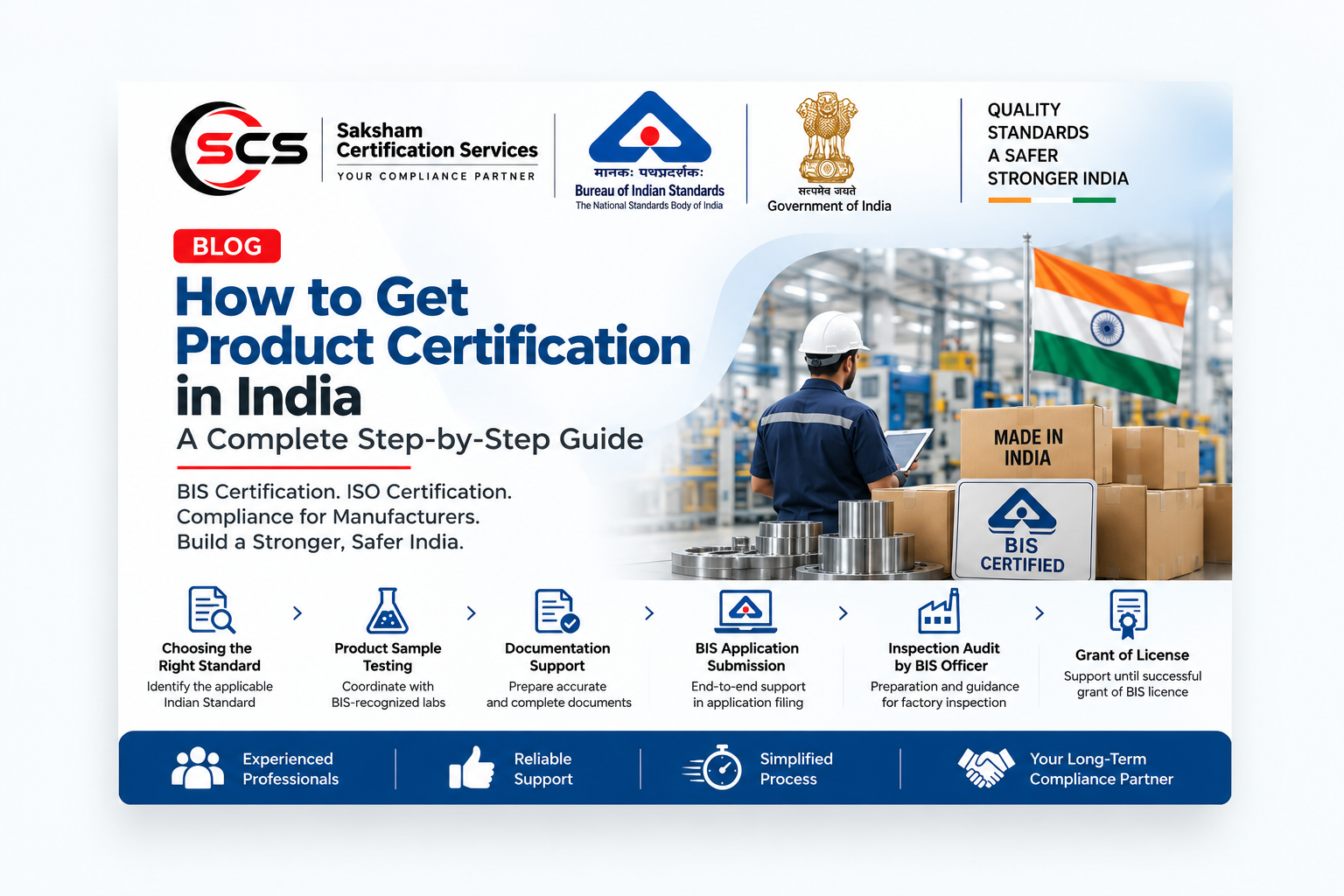
How to Get Product Certification in India: A Complete Step-by-Step Guide
For manufacturers planning to sell products in the Indian market, understanding the applicable certification and compliance requirements is an important part of doing business. Depending on the type of product, applicable Indian Standard, industry requirements, and regulatory framework, a manufacturer may need certifications such as BIS Certification, while management system certifications such as ISO Certification may also be relevant for strengthening internal processes and demonstrating a commitment to quality.
At Saksham Certification Services, we assist manufacturers and businesses in understanding their certification requirements, identifying the appropriate standards, preparing documentation, coordinating product testing, submitting applications, supporting inspections, and maintaining compliance after certification.
In this guide: We explain the difference between BIS and ISO Certification, when BIS Certification becomes mandatory, how manufacturers can determine the correct certification requirement, and the complete BIS Certification process in India.
What Is Product Certification in India?
Product certification is a process through which a product is evaluated against applicable technical, quality, performance, and safety requirements. In India, certain categories of products are regulated under standards and certification schemes administered by the Bureau of Indian Standards (BIS).
For products covered under mandatory BIS requirements, manufacturers generally cannot manufacture, import, distribute, or sell the regulated product in the Indian market without obtaining the applicable BIS approval and using the required Standard Mark in accordance with the relevant scheme.
BIS Certification therefore plays an important role in market compliance. It helps demonstrate that the product has been assessed against the applicable Indian Standard and provides customers with greater assurance regarding product quality, safety, reliability, and conformity.
BIS Certification vs ISO Certification: What Is the Difference?
Manufacturers frequently ask us whether they require BIS Certification, ISO Certification, or both. Although both are associated with quality and compliance, they serve different purposes.
| Basis | BIS Certification | ISO Certification |
|---|---|---|
| Main Purpose | Product conformity with applicable Indian Standards | Certification of management systems and organizational processes |
| Applicable To | Specific products covered by applicable BIS standards or certification requirements | Organizations looking to implement recognized management systems |
| Mandatory? | Mandatory for products notified under compulsory certification requirements | Generally voluntary unless required by a contract, customer, tender, industry, or other applicable requirement |
| Focus | Product safety, performance, quality and conformity | Quality, environmental, information security, occupational safety or other management systems |
| Examples | BIS certification against an applicable Indian Standard | ISO 9001, ISO 14001, ISO 45001 and other management system standards |
Which Certification Should a Manufacturer Choose?
The answer depends on the product and the manufacturer's objective. If your product falls under a category for which BIS Certification has been made compulsory, obtaining the applicable BIS licence or registration is a regulatory requirement for placing that product in the Indian market.
ISO Certification, on the other hand, generally focuses on how an organization manages its processes. For example, ISO 9001 relates to quality management systems and may help a manufacturer establish structured processes, improve consistency, and demonstrate its quality management practices to customers and business partners.
Important: Having ISO Certification does not automatically replace a mandatory BIS Certification requirement. If a product is covered under compulsory BIS certification, the manufacturer must comply with the applicable BIS requirements independently.
Why Is BIS Certification Important for Manufacturers?
BIS Certification is not simply a certificate to be obtained for documentation purposes. For regulated products, it forms an important part of legal and market compliance in India.
- Market Compliance: It helps manufacturers meet mandatory certification requirements applicable to regulated products.
- Product Safety: Products are evaluated against prescribed Indian Standards covering relevant safety and performance requirements.
- Customer Confidence: Certification helps provide customers with greater assurance that the product conforms to the applicable standard.
- Indian Standards Compliance: Manufacturers must manufacture and maintain the product in accordance with the applicable Indian Standard and BIS requirements.
- Business Continuity: Proper compliance can help manufacturers avoid unnecessary delays, regulatory issues, or interruptions in selling regulated products.
Complete BIS Certification Process in India
The exact procedure may vary depending on the product, applicable Indian Standard, BIS scheme, manufacturing setup, and regulatory requirements. However, for many manufacturer certification applications, the process broadly involves the following stages.
Step 1: Choosing the Right Standard as per the Requirement
The first and one of the most important steps is identifying the correct Indian Standard (IS) applicable to your product. A product may have different standards depending on its type, composition, intended use, technical specifications, or manufacturing process.
Saksham Certification Services assists manufacturers in understanding the applicable certification requirement and identifying the relevant standard based on the product details provided by the manufacturer.
Step 2: Product Sample Testing
Once the applicable standard has been identified, the product may need to be tested against the prescribed requirements of that Indian Standard. Testing helps determine whether the sample complies with the required parameters.
We support manufacturers in coordinating the testing process and in understanding the test parameters and documentation required for the certification application.
Step 3: Documentation Preparation
Accurate and complete documentation is essential for a smooth BIS Certification process. Depending on the applicable scheme and product, documents may include:
- Manufacturing unit details
- Business registration documents
- Product specifications
- Manufacturing process details
- List of machinery and manufacturing equipment
- Testing equipment details
- Quality control information
- Applicable test reports
- Factory layout and other supporting records, where applicable
Saksham Certification Services helps manufacturers organize the required documentation, review the information before submission, and reduce avoidable documentation gaps.
Step 4: BIS Application Submission
Once the testing and documentation are ready, the BIS application is prepared and submitted through the applicable BIS process along with the required information and supporting documents.
Our team assists clients throughout the application submission process and helps address documentation observations or queries that may arise during application processing.
Step 5: Inspection / Audit by BIS Officer
Depending on the applicable BIS certification scheme, a BIS officer may conduct an inspection of the manufacturing facility. During the inspection, the officer may review the manufacturing process, testing facilities, quality control arrangements, records, equipment, and the manufacturer's capability to consistently produce goods conforming to the applicable Indian Standard.
Saksham Certification Services supports manufacturers in preparing for the inspection by reviewing required records, documentation, equipment details, and compliance readiness before the audit.
Step 6: Grant of BIS Licence
After successful completion of the applicable testing, documentation review, inspection, and closure of any observations or queries, BIS may grant the licence to the manufacturer.
Once the licence is granted, the manufacturer must continue to comply with the conditions of the licence, applicable Indian Standard, marking requirements, testing requirements, record-keeping obligations, and ongoing surveillance provisions.
How Long Does BIS Certification Take?
For a well-prepared manufacturer where product testing, documentation, factory infrastructure, and compliance requirements are properly addressed, the overall certification exercise may commonly take approximately 1.5 to 2 months.
Once a complete BIS application has been formally submitted, the subsequent processing, inspection, query resolution, and licence grant may in suitable cases be completed within approximately one month. However, the actual timeline depends on factors such as the applicable product and scheme, BIS processing, inspection scheduling, testing requirements, documentation completeness, and the time taken to resolve observations.
Tip for manufacturers: Correct standard identification, proper product testing, complete documentation, and inspection readiness before application submission can significantly reduce avoidable delays.
Certification Does Not End After the BIS Licence Is Granted
Obtaining the BIS licence is an important milestone, but manufacturers must continue maintaining compliance throughout the validity of the licence. Product quality, internal testing, records, marking, production controls, and other applicable requirements must continue to be maintained.
Post-Certification Support from Saksham Certification Services
Saksham Certification Services supports clients not only during the initial certification process but also after the licence has been granted. Our objective is to help manufacturers maintain organized compliance and remain prepared for ongoing BIS requirements.
Assistance in maintaining important certification, production, testing, quality, and compliance records required under the applicable certification framework.
Support in understanding continuing obligations under the applicable Indian Standard and BIS licence conditions.
Assistance in preparing documentation, records, testing information, and factory compliance requirements for periodic inspections and surveillance activities.
Support in reviewing and preparing appropriate responses to BIS observations, clarification requests, or compliance-related queries.
Continued assistance with certification-related documentation, updates, renewals, modifications, and other applicable compliance requirements.
Why Work with Saksham Certification Services?
The BIS Certification process involves technical standards, product testing, documentation, application requirements, factory inspection, and ongoing compliance. Missing an important requirement at any stage can result in unnecessary queries or delays.
Saksham Certification Services works with manufacturers to make this process more structured and manageable. From determining the applicable certification requirement to supporting the manufacturer after the licence is granted, we provide practical assistance throughout the certification lifecycle.
Need BIS or ISO Certification Support?
If you are a manufacturer and are unsure whether your product requires BIS Certification, which Indian Standard applies, or what documents and testing are required, Saksham Certification Services can assist you throughout the process.
Contact Saksham Certification Services to discuss your product, certification requirement, BIS application, ISO Certification requirement, testing, inspection preparation, or ongoing compliance support.
Frequently Asked Questions
Is BIS Certification mandatory for every product?
No. BIS Certification is mandatory for products covered under applicable compulsory certification requirements. Other products may fall under voluntary certification or may be governed by different regulatory requirements.
Does ISO 9001 replace BIS Certification?
No. ISO 9001 relates to a quality management system, while BIS Certification generally relates to product conformity with an applicable Indian Standard. Where BIS Certification is mandatory for a product, ISO 9001 does not replace that requirement.
How can I know which BIS standard applies to my product?
The applicable standard depends on the product category, specifications, intended use, composition, and regulatory requirements. Saksham Certification Services can assist in reviewing the product details and identifying the relevant certification requirements.
What happens after BIS Certification is granted?
The manufacturer must continue complying with the applicable Indian Standard, licence conditions, product testing requirements, record maintenance requirements, marking requirements, and BIS surveillance or inspection requirements, as applicable.
Disclaimer
The information provided in this article is intended for general informational and educational purposes only. Certification requirements, applicable standards, procedures, fees, documentation, testing requirements, inspection requirements, and processing timelines may vary depending on the product, applicable certification scheme, regulatory notifications, and requirements issued by the competent authority from time to time. The timelines mentioned in this article are indicative and should not be considered a guarantee of certification or licence issuance within a specific period. Applicants should verify the latest applicable requirements before proceeding. Saksham Certification Services is an independent certification consultancy and support service provider and does not represent or act on behalf of the Bureau of Indian Standards (BIS), ISO, or any government authority. Final approval, certification, registration, or grant of licence remains solely at the discretion of the respective competent authority or certification body.