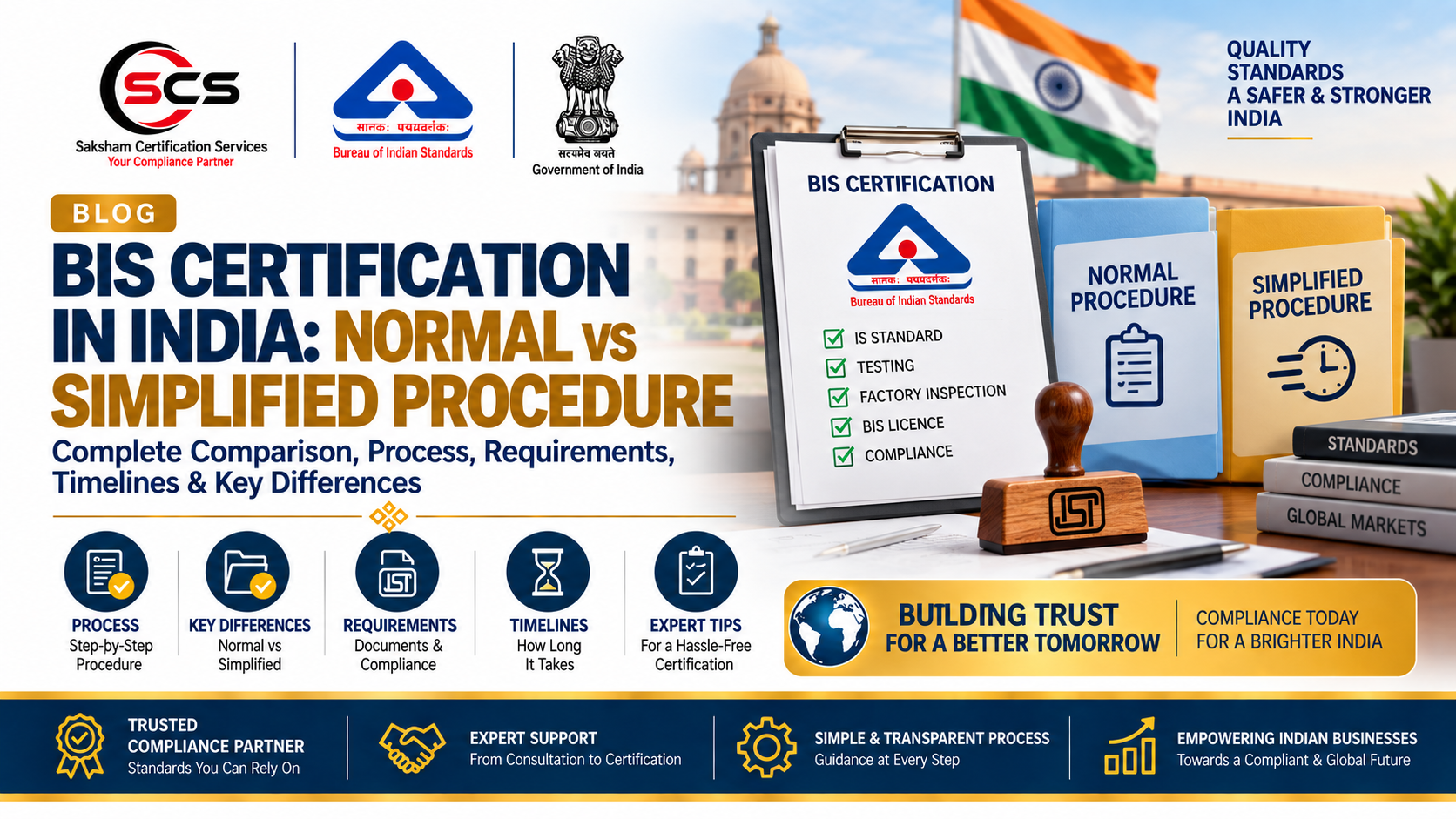
BIS Certification in India: Normal Procedure vs Simplified Procedure
Understand the difference between the Normal Procedure and Simplified Procedure for BIS Product Certification, including the application process, testing, factory inspection, timelines and key requirements.
BIS Certification is an important regulatory requirement for manufacturers whose products are covered under mandatory Indian Standards and applicable Quality Control Orders (QCOs). Depending on the product and applicable certification framework, manufacturers may need to obtain a BIS licence before manufacturing, importing or commercially supplying the covered product in India.
For products covered under BIS Scheme-I (ISI Mark Scheme), there are two options for obtaining a product certification licence: Option 1 (erstwhile Normal Procedure) and Option 2 (erstwhile Simplified Procedure).
Although both procedures ultimately aim to establish conformity of the product with the applicable Indian Standard, the sequence of application, testing, inspection and licence grant is different.
Important Terminology
BIS currently describes the two routes as Option 1 and Option 2. Option 1 is the procedure formerly known as the Normal Procedure, while Option 2 is the procedure formerly known as the Simplified Procedure.
What Is BIS Product Certification?
The Bureau of Indian Standards (BIS) is India's national standards body. Under its product certification framework, BIS assesses whether a manufacturer's product conforms to the applicable Indian Standard and whether the manufacturer has the required manufacturing infrastructure, process controls, quality-control systems and testing capabilities.
Under Scheme-I, a BIS licence permits the manufacturer to use the applicable Standard Mark (ISI Mark) on certified products, subject to the conditions of the licence and applicable requirements.
BIS may also conduct factory and market surveillance during the operation of the licence to verify continuing conformity of certified products.
Normal vs Simplified Procedure: At a Glance
| Parameter | Option 1 – Normal Procedure | Option 2 – Simplified Procedure |
|---|---|---|
| Application | Application is submitted with required documents. | Application is submitted along with the applicable self-evaluation / verification requirements and supporting documents. |
| Product Testing | Samples are generally drawn during the BIS factory visit and sent for testing as applicable. | Testing is generally arranged before or along with the application as prescribed for the product and procedure. |
| Factory Assessment | BIS assesses manufacturing and testing capabilities and draws samples during the assessment. | Factory assessment is conducted after the application and supporting evidence are available as required. |
| Speed | Generally takes longer because testing follows the factory assessment in the typical process. | Designed to facilitate faster processing where applicable. |
| Manufacturer Responsibility | Conformity is established through the prescribed BIS assessment and testing process. | Manufacturer has greater responsibility for ensuring product conformity before applying under the applicable route. |
| Best For | Products / situations where Option 1 is applicable or preferred. | Products eligible for Option 2 and manufacturers who are prepared for faster certification processing. |
What Is the Normal Procedure for BIS Certification?
The Normal Procedure, now referred to by BIS as Option 1, is one of the routes available for obtaining a BIS product certification licence under Scheme-I.
In the typical Option 1 process, the manufacturer submits the BIS application with the required information and documents. BIS then carries out an assessment of the manufacturing premises to evaluate the manufacturing infrastructure, production process, quality-control arrangements and testing capabilities.
During the assessment, samples may be drawn for testing in an independent laboratory, or testing may be carried out at the manufacturing premises where the applicable certification process permits factory testing.
Typical Steps Under Option 1
- Identify the applicable Indian Standard (IS).
- Review the applicable product manual, testing requirements and grouping guidelines.
- Prepare the manufacturing facility, quality-control system and testing arrangements.
- Submit the BIS application and required documents through the BIS online portal.
- BIS conducts the required factory assessment.
- Samples are drawn and tested as prescribed.
- The test results and assessment findings are evaluated by BIS.
- If the requirements are satisfactorily fulfilled, BIS may grant the licence subject to applicable conditions.
What Is the Simplified Procedure for BIS Certification?
The Simplified Procedure, now referred to by BIS as Option 2, was introduced to make the BIS licensing process more predictable and reduce the time involved in obtaining certification for eligible products.
Under this route, the manufacturer is expected to establish conformity through the prescribed testing and documentation requirements and submit the application accordingly. This allows the certification process to progress more quickly than the typical sequence under Option 1.
BIS has also identified certain products for which applications are required to be submitted under Option 2. Therefore, manufacturers should always check the current BIS requirements for the specific product instead of assuming that either procedure can be selected freely.
Typical Steps Under Option 2
- Identify the applicable Indian Standard and product scope.
- Review the applicable product manual, testing requirements and grouping guidelines.
- Arrange the required product testing through the prescribed laboratory / testing arrangement.
- Prepare the required self-evaluation / verification documentation and supporting information.
- Submit the BIS application with the required test reports and documents.
- BIS assesses the application and conducts the required factory inspection / assessment.
- Upon satisfactory compliance with the applicable requirements, BIS may grant the licence.
The Key Difference
The major difference is when product conformity is established in the certification process. Under Option 1, the factory assessment and sample testing form a key part of the process after application. Under Option 2, the manufacturer generally establishes conformity through the prescribed testing and documentation before or along with the application, enabling faster processing where the route is applicable.
Which Procedure Is Faster?
In general, Option 2 (Simplified Procedure) is intended to provide faster processing than Option 1. BIS states in its FAQ that the average time for grant of licence is generally around one month under Option 2 and around four months under Option 1, calculated from receipt and recording of a complete application. Actual processing time can vary depending on factors such as queries, inspections, testing, sample deposition and fee-related requirements.
BIS's stated general average timeline for Option 1, subject to the circumstances of the application.
BIS's stated general average timeline for Option 2, subject to the circumstances of the application.
Is the Simplified Procedure Better?
Not necessarily in every situation. The simplified procedure can be advantageous when the product is eligible for Option 2 and the manufacturer is fully prepared with the required testing, documentation, manufacturing controls and quality systems.
However, faster processing also means that the manufacturer needs to be well prepared before submitting the application. If the product fails the applicable tests or the documentation and factory arrangements are not adequate, the expected time advantage may be lost.
Therefore, the right question is not simply "Which procedure is faster?" but rather "Which procedure is applicable to my product, and is my manufacturing facility ready for it?"
When Should a Manufacturer Consider Option 2?
- The product is covered under the applicable BIS requirements for Option 2.
- The manufacturer has a clear understanding of the applicable Indian Standard.
- Required product testing can be completed through the prescribed testing arrangement.
- Product specifications, drawings, BOM and technical documentation are ready.
- Manufacturing and quality-control processes are already aligned with the applicable Indian Standard.
- The manufacturer wants to minimise avoidable delays in obtaining the BIS licence.
Common Mistakes Manufacturers Should Avoid
Not every product follows exactly the same certification route. Product-specific BIS guidelines should be checked.
Samples and test configurations should be selected according to the applicable Indian Standard, product manual and grouping requirements.
Missing specifications, drawings, manufacturing information or quality-control documents can result in queries and delays.
Manufacturers should ensure that production controls, testing facilities, inspection arrangements and records are ready for assessment.
BIS certification involves product conformity as well as manufacturing and quality-control capabilities. Both need to be addressed.
BIS Certification Readiness Checklist
How Saksham Certification Services Can Help
Choosing the correct BIS certification route and preparing the application correctly can significantly reduce avoidable delays. Saksham Certification Services can support manufacturers throughout the certification process.
BIS Applicability Assessment
Understand whether your product requires BIS certification and identify the applicable certification framework.
IS Code Identification
Identify the relevant Indian Standard, product scope, testing requirements and applicable guidelines.
Testing Support
Assistance in understanding applicable testing requirements, sample selection and documentation.
Documentation
Support with technical documentation, application preparation and BIS certification requirements.
Factory Readiness
Preparation support for manufacturing processes, quality control, testing facilities and BIS assessment.
BIS Certification Consultancy
End-to-end assistance in navigating the BIS product certification process.
Need Help With BIS Certification?
Not sure whether your product falls under the Normal or Simplified Procedure? Let Saksham Certification Services assess your product and help you plan the appropriate BIS certification route.
Contact Saksham Certification ServicesFrequently Asked Questions
1. What is the difference between Normal and Simplified BIS certification?
The Normal Procedure is now referred to as Option 1, while the Simplified Procedure is now referred to as Option 2. The key difference is the sequence in which application, testing, conformity evidence and factory assessment are carried out.
2. Which BIS procedure is faster?
Generally, Option 2 is faster. BIS states that the average time for grant of licence is generally around one month under Option 2 compared with around four months under Option 1, although actual timelines vary depending on the application and other factors.
3. Can every manufacturer choose the Simplified Procedure?
Not necessarily. The applicable route depends on the product, BIS requirements and specific certification provisions. Some products may be specifically required to follow Option 2, while certain products or situations may continue to be processed under Option 1.
4. Is factory inspection required under the Simplified Procedure?
The simplified route does not eliminate BIS assessment requirements. BIS assesses the manufacturing and testing capabilities as prescribed for the applicable certification process.
5. Does BIS certification only involve product testing?
No. BIS certification also involves assessment of manufacturing infrastructure, production processes, quality-control arrangements and testing capabilities, in addition to establishing product conformity with the applicable Indian Standard.
Conclusion
BIS certification in India is not simply a matter of submitting an application. Manufacturers need to understand the applicable Indian Standard, certification route, testing requirements, documentation and factory readiness.
The Normal Procedure (Option 1) and Simplified Procedure (Option 2) follow different processing sequences, with Option 2 generally designed for faster certification processing where applicable.
For manufacturers, the best approach is to determine the correct route early, complete the required testing and documentation, and ensure that the manufacturing facility is ready before starting the BIS application process.
If you are planning to obtain BIS certification for your product, getting the applicability and procedure right at the beginning can save significant time, cost and effort later.
Regulatory Note: BIS procedures, product-specific requirements, applicable standards, testing requirements and processing timelines may be revised from time to time. Manufacturers should verify the latest BIS requirements and product-specific guidelines before making certification or compliance decisions.
Reference: Bureau of Indian Standards – Product Certification Process, Product Certification FAQ and Scheme-I guidelines.